
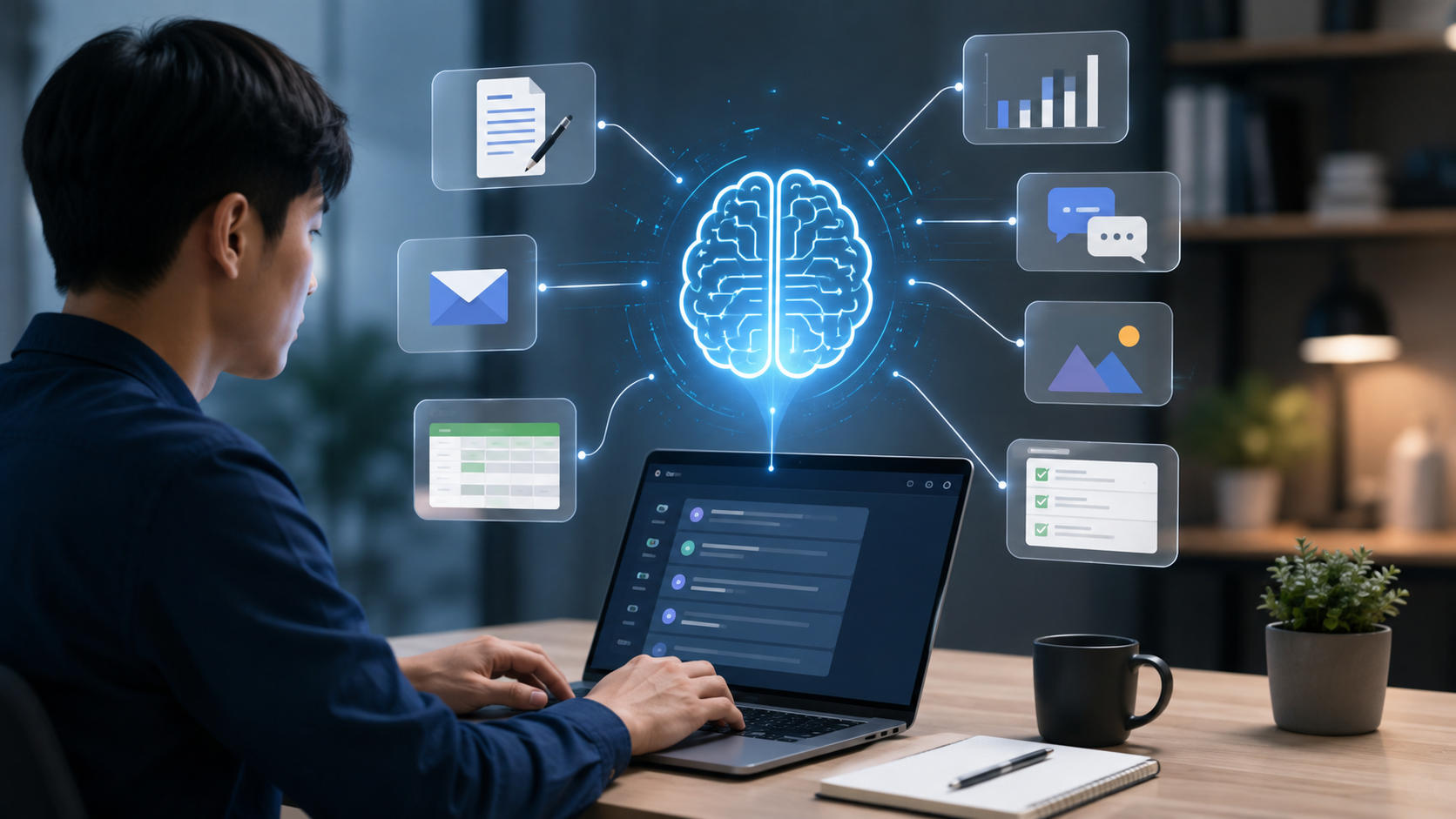
Generative AI has moved beyond being a futuristic technology discussed mainly by researchers and technology companies. It is increasingly becoming part of ordinary digital work, helping people write emails, summarize documents, organize information, create presentations, analyze data, and complete tasks that once required much more time.
What makes this shift particularly interesting is that generative AI is not necessarily replacing the tools people already use. Instead, it is changing the way people interact with them. Tasks that once involved several steps can sometimes be completed through a simple instruction, while routine digital work is becoming more automated and conversational.
From Tools to Digital Assistants
For years, digital work required people to understand how individual software tools worked. Writing meant opening a word processor, creating a document, formatting it, and revising it manually. Data analysis often required spreadsheets and formulas. Creating presentations involved choosing layouts, writing content, and arranging visual elements.
Generative AI introduces another layer between the user and these tools.
Instead of manually performing every step, people can describe what they want in natural language. An AI assistant can then help produce a first draft, reorganize information, suggest improvements, or explain complicated material.
This does not eliminate traditional software. It changes the starting point. Users increasingly begin with an idea or instruction rather than a blank document or spreadsheet.
Everyday Writing Is Becoming Faster
One of the most visible effects of generative AI is the way people handle written communication.
Emails, reports, meeting notes, product descriptions, internal announcements, and other routine documents can take considerable time to prepare. Generative AI can help create an initial version, adjust the tone, simplify complicated language, or turn notes into a more structured message.
The biggest benefit may not be that AI produces perfect writing. Instead, it reduces the friction of getting started.
A person who previously spent 20 minutes staring at a blank page may now begin with an AI-generated draft and spend those 20 minutes editing, checking, and improving it.
That changes writing from a process of creating everything from scratch into a process of reviewing and refining.
Information Overload Becomes Easier to Manage
Modern digital work produces an enormous amount of information. Emails, chat messages, reports, presentations, documents, spreadsheets, and meeting transcripts can quickly become difficult to keep up with.
Generative AI can help turn large amounts of information into something more manageable.
A long document can be summarized. A meeting transcript can be converted into key points. Several pieces of information can be organized into categories. Complex material can be explained in simpler language.
This can make digital work feel less overwhelming, particularly when the challenge is not finding information but understanding and organizing it.
However, summaries still need to be checked. AI can misunderstand context, overlook important details, or produce conclusions that sound convincing without being accurate.
The Spreadsheet Is Getting a New Interface
Spreadsheets have long been among the most powerful digital productivity tools, but they can also have a steep learning curve.
Generative AI is making it easier for people to interact with data without remembering every formula or function. Users can describe what they want to calculate, identify patterns they want to investigate, or ask for help understanding a dataset.
This could make analytical tasks more accessible to people who are comfortable working with information but less familiar with spreadsheet formulas.
At the same time, AI-generated calculations should not automatically be trusted. Important financial, operational, or business decisions still require verification and human judgment.
Meetings May Produce More Useful Work
Meetings often create another form of digital workload: notes.
Someone has to remember what was discussed, identify decisions, record action items, and communicate the results afterward. Generative AI can assist with these tasks by transforming conversations or notes into structured summaries.
The potential advantage is significant. Instead of spending as much time documenting a meeting, workers can focus more of their attention on the discussion itself.
But there is also an important question about accuracy and privacy. Sensitive conversations may contain information that should not be processed casually by an AI system. Organizations need clear rules about what information can be shared with AI tools and how that information is handled.
Creativity Is Becoming More Collaborative
Generative AI is also changing creative digital work.
People can use AI to brainstorm headlines, explore design concepts, generate variations of an idea, create outlines, or experiment with different approaches. The technology can act as a source of possibilities rather than a final decision-maker.
This creates an interesting shift in the creative process.
Instead of asking AI to create something perfect immediately, users can use it to generate alternatives and then decide which ideas are worth developing.
The human role therefore remains important. Taste, context, originality, judgment, and understanding of the audience are difficult to reduce to a simple prompt.
The New Skill: Knowing What to Ask
As AI becomes more capable, digital literacy may increasingly involve more than knowing how to operate software.
People may need to become better at explaining goals, providing context, identifying limitations, and evaluating results.
A vague instruction can produce a generic answer. A clear request containing relevant background information and specific requirements can produce something much more useful.
This means that communication itself becomes an important digital skill.
The ability to recognize when an AI response is incomplete or incorrect may become just as important as the ability to generate one.
AI Is Changing the Shape of Work, Not Just the Speed
It is tempting to describe generative AI mainly as a productivity tool. In many situations, however, its impact goes deeper than simply helping people finish tasks faster.
When routine work becomes easier, people may spend more time on decisions, problem-solving, communication, and strategy.
A marketer may spend less time drafting variations and more time deciding which message best fits an audience. A manager may spend less time organizing notes and more time thinking about priorities. A researcher may spend less time sorting information and more time evaluating what it means.
The technology therefore has the potential to change not only how quickly work gets done, but also where human attention is directed.
The Importance of Human Oversight
Despite its growing usefulness, generative AI is not an independent replacement for human judgment.
AI systems can produce incorrect facts, misunderstand instructions, invent information, or miss important context. The more consequential the task, the more important verification becomes.
For everyday digital work, the most practical approach may be to treat AI as a capable assistant rather than an unquestionable authority.
People can let AI handle repetitive first drafts and organizational tasks while keeping responsibility for decisions, accuracy, sensitive information, and final approval.
A More Conversational Digital Workplace
The most important change may be the gradual shift from software that people operate to software that people can communicate with.
Instead of learning every function inside a tool, users can increasingly describe their objectives in ordinary language and let AI help determine the steps.
That does not mean traditional interfaces will disappear. Buttons, menus, spreadsheets, and documents will remain useful. But natural-language interaction could become another layer connecting people with their digital tools.
For everyday workers, this may make technology feel less like a collection of separate applications and more like a flexible workspace.
What Comes Next?
Generative AI is still developing, but its influence on everyday digital work is already becoming easier to see.
The technology is helping people draft, summarize, organize, analyze, brainstorm, and communicate. Its most meaningful contribution may not be completing entire jobs automatically, but reducing the repetitive parts of digital work and giving people more time to focus on tasks that require judgment and creativity.
The future of digital work may therefore be less about humans versus AI and more about how effectively the two can work together.
As generative AI becomes a normal part of workplace software, the people who benefit most may not simply be those who use AI the most. They may be the ones who understand when to use it, what to ask it, and when not to trust its answer.
That could become one of the defining digital skills of the next few years.











Leave a Reply